The night journey of Prophet Muhammad
Surah XVII of the Qur'an tells the story of the night journey during which the Archangel Gabriel led the Prophet Muhammad to the "very distant mosque" and then to heaven. Along the way they met Abraham, Moses and Jesus. In the Islamic religion, this journey is commemorated on the feast of al-Isra Val-Mi'raj. Almost from the beginning of Muhammad's teachings, Jerusalem appears as a holy city, and tradition has it that the prophet first turned to the city when he said his prayers. Only later did he begin to turn towards Mecca in prayer. Jerusalem was first conquered in the name of Islam by Omar, the second caliph, in 638. The construction of the Mosque of the Rock half a century later firmly established Jerusalem's place in Islamic theology. The rock at the centre of the mosque is considered the centre of the world.
On Judgment Day, the angel stands on this holy rock, blows the horn of ram's horn. A bridge will then descend from the Mount of Olives, and the dead will be able to cross the seven arched gates in front of the mosque to reach the bridge. Before they can pass under the arcade arches, however, they must give an account of their lives.
The Muslim Quarter and the historical changes in the city
The vast majority of Jerusalem's population is Muslim. Religious matters are decided by the head of the Supreme Muslim Council, the Mufti. This council oversees the shari'ah, the religious courts, and manages the blindfold, the fund used to maintain Islamic religious institutions and Muslim holy sites. Every year, thousands of Israeli Muslims make the pilgrimage to Mecca. The Muslim quarter, hidden from prying eyes, is the largest and most densely populated part of the Old City. This quarter includes part of the great city of Herod's time, as well as the northern area of the city, which was zoned by the third tree built by Herod Agrippa in the 1st century AD.
During the Fatimid period, this was the Jewish quarter, and later, during the Crusades, many churches stood here. There are some interesting Mameluk buildings in the area near the Temple Mount. Jerusalem took on its present architectural appearance between 1291 and 1571, from the beginning of the Mameluk period until the Ottoman-Turkish conquest. Despite the country's economic decline, Jerusalem became an important centre for Islam, and a number of religious buildings were erected: inns for pilgrims, Islamic seminaries (madrasas) and tombs. The Sitt Tunsuk Palace in present-day Maalot Hamadrasa Street was a 16th-century inn where visiting Dervishes stayed. This building bears the hallmarks of Mamluk architecture, such as the decoration in black, white and red stone carvings. The ornate entrance consists of a single rectangular doorway with a flat eyebrow stone above it, surmounted by an arch decorated with geometric and richly floral ornamentation. The name of the builder or benefactor is often inscribed, and quotations from the Koran are sometimes read. The Sukk al-Kattanin, or Cotton Weavers' Market, is in fact a long street that runs from Haggai Street to the entrance to the Temple Mount. The shops lining both sides of the street were built between 1136 and 1137.
The significance of the Rock Mosque and the al-Aqsa Mosque
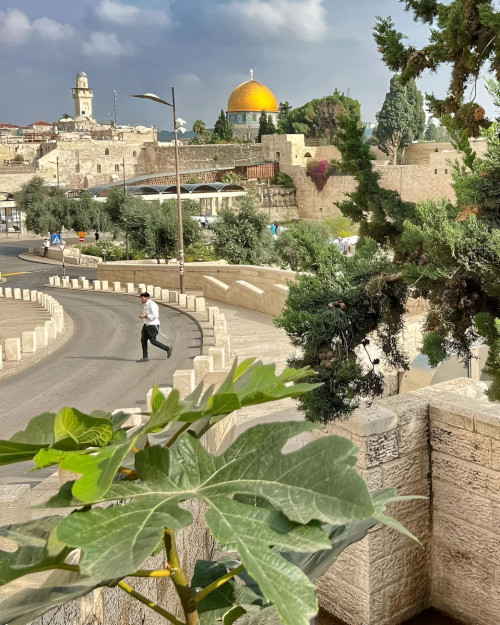
The Dome of the Rock Mosque is the third holiest site in Islam, after the Kaaba Stone in Mecca and the Medina Mosque. It stands on a square platform with a flight of steps leading up to the mosque on each side.
The graceful arcades above the staircase are called scales: tradition has it that on the Day of Judgement, a scale will stand beneath each of them to "weigh" the soul. The octagonal building is topped by a golden dome, and its walls are decorated with marble slabs in a variety of patterns and tiles with geometric and floral ornamentation made in Kazan, Persia. In the centre of the mosque stands the sacred rock. According to Islamic tradition, it marks the centre of the world, and on Judgement Day the throne of God will stand on this rock. The indentation in the rock is believed to be the footprints of Muhammad, who ascended to heaven from this place. In the cave under the rock is the shrine of Elijah (Elijah) and Abraham. While the Rock Mosque preserves the memory of the Prophet Muhammad and is an important pilgrimage site, the al-Aqsa Mosque is a place of prayer for up to 5,000 worshippers. The artefacts recovered during the restoration of the Rock Mosque and al-Aqsa Mosque are on display in the Islamic Museum next to the mosque. Under the al-Aqsa Mosque is the double gate that allowed access to the Temple Mount during the reign of Herod. Solomon's stables stand under the southeast corner of the hill. The vaulted ceiling is supported by columns. The underground room, however, is not of Solomon's time but of Herod's, and was indeed converted into stables during the Crusades.