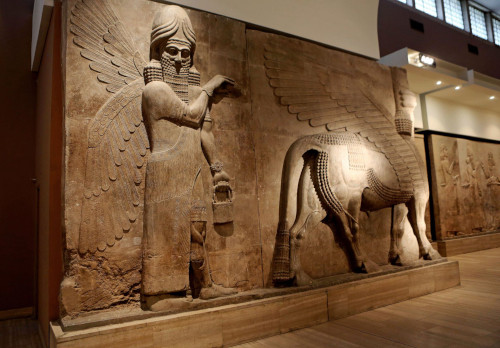
The Mesopotamian civilisation is a creative and organising centre of power and knowledge, destined to last for millennia. It was many years before the Assyrian rulers and their dreaded hordes ravaged Palestine, leaving an indelible mark on the Bible.
Its cradle lay opposite the Persian Gulf, in a 'new' land, an area with the potential for northward expansion and the birthplace of the network of cities that later became known as Sumer.
Mesopotamia at the dawn of social and technological development
More than 5,000 years ago, this region was a difficult place for human settlement because there was too much water and the flooding of the two rivers was too much for humans to cope with. On the slopes of the Zagros mountain range (between Iraq and Iran) and the Taurus Mountains (between Iran, Iraq and Turkey), as well as in Lebanon and Palestine, the first important innovations in food production (crops and livestock) and the development of community life (large villages) from the Neolithic period (10 000-3500) can be found everywhere. If we connect the mountainous regions with an imaginary line in our mind's eye, we obtain an arc called the Fertile Crescent. At the end of the Neolithic (6000-3500), important achievements were made in the region, especially in the field of technology. Gradually, the Mesopotamian population needed more and more space to exploit the innovations, which enabled intensive cereal cultivation and the full development of a new social trend, the division of labour and the separation of social roles. In fact, it is in this period that what we call society is formed, that is, a group of people who, acting in different roles at different levels of the hierarchy, contribute to the growth of the group as a unit. These fundamental changes were accompanied by new forms of settlement and community life. Large villages and networks of villages have been created. This was not, however, the time of the development of Lower Mesopotamia, but of the area east of the Zagros range, where Susa was located.
Susa is the birthplace of an extremely ancient culture, the Elamite civilisation, which played a vital role in the history of the Middle East. The region was named after the city of Susa, which played a prominent role for thousands of years, during the rise of the Persian Empire (539-323), and became one of its capitals. The region of Susa (in present-day Iran) was geographically suitable for the first cities, but it soon took over from Susa as the centre of development and power in the emergence of the city-state of Sumer.
The Sumerians and the rise of the first city states
Around 3500 BC, Lower Mesopotamia steadily extended its power into the surrounding areas.
The population created a veritable network of villages, some of which developed into towns thanks to their religious, administrative and military importance. Among these towns, Uruk was the most important, but Eridu, Ur, Kis, Umma and Larsa should also be mentioned. Beyond the mountain ranges of Zagros, Susa was still the main power, but other cities began to rise in the east.
Writing and the emergence of statehood
Within a short period of time (3000-2900), the new Mesopotamian culture had created, or rather perhaps invented, the city, the state and the writing system. The population increased enormously in relation to the population of around 3500, largely due to the cultivation of cereals and early forms of irrigation canal construction, the development of land parcels and, more generally, the abundance of energy resources. The Sumerians in the early phase had sufficient labour to build huge structures such as temples and palaces. They were able to manage the vast quantities of goods they accumulated and organise the distribution of food and supplies, as well as sharing responsibilities and tasks.
The heritage of Mesopotamia - the impact of cuneiform
In Mesopotamia, writing was one of the most important cultural factors. Called cuneiform because of the wedge-like shape of the characters carved into wet-matter tablets, stone statues and rock surfaces, writing survived for 3,000 years and influenced the literature and even the mythology of its inventors. The Sumerian writing system spread throughout the Middle East. In the East, an offshoot of the Elamite civilisation, the Susa culture, adopted the new invention, adding its own original elements. In the north, the Akkadians (then Assyrians and Babylonians), then Hurrians, the Hittites of Anatolia and later a group of people called the Uraturians, adopted cuneiform writing.
In the western regions, the Semitic peoples of Ebla, or "the land of Amurru" (the name given to Palestine and Syria at the time), also adopted the Mesopotamian script. Thanks to the invention of writing and the fact that it was so widely used in various Mesopotamian empires in the 3rd millennium, there are now many written sources that can be used to try to understand the history and culture of these ancient peoples.
Within a millennium, there have been a succession of major power players: the Sumerians in the so-called Early Dynastic period, and the Akkadians during the Akkadian Empire founded by the famous King Sarrukin. This was followed by a transitional period of barbarian conquests, and finally, with the establishment of the Urartian dynasty, the 'Sumerian Renaissance', known in the trade as the 'Urartian Dynasty', began.