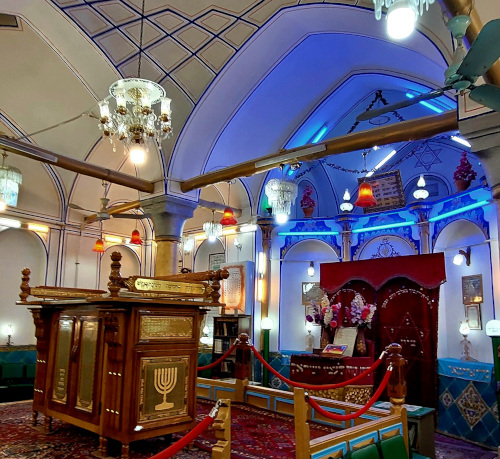
"Hear Israel! The Eternal is our Lord. The Eternal is one."
By some estimates, a third of Western civilisation bears the mark of its Jewish heritage. We sense its power when we give our children, sometimes unknowingly, biblical names (Aaron, Zsuzsanna) in our art (Michelangelo's David) and in our national tradition. (When Sándor Petőfi refers to "the god of the Hungarians", he is extending the Mosaic tradition. But the real influence of ancient Jewry is most evident in the extent to which their vision has been taken over by Western civilisation in the most profound aspects of life.
If we look at the country, the people, the history from which this effect comes, we are surprised. We would expect it to be as impressive as the impact it has had. But it is not. Nor were the Hebrews the first to appear on the stage of history, chronologically. When they finally settled, 'the Promised Land' was monotonous and featureless, some 200 kilometres long, less than half that wide, and the land of Canaan itself was probably even smaller. Jewish history is nothing special to outsiders. Not boring, but very similar to the history of countless other small peoples.
The meaning of God
"In the beginning, God" - The Jewish search for meaning is rooted, from beginning to end, in an understanding of the Supreme Being. Whatever the philosophy of the people, they must take account of an Other with a capital letter. There are two reasons for this. First, in the theological approach, man did not create himself, which implies that mankind must have been created by someone, an Other outside of himself. Let us endow this Other, from whom we come, with an underlying content. This goes beyond the limits of understanding. Faced with the Other, the question arises: is there a meaning to existence? Four qualities would argue against this: if it were commonplace, chaotic, amoral or hostile. The Jews avoided ordinariness by personifying this Other poetically. The idea that the world was created from inanimate matter was invented later. The early world view is alive and well.
The poetic beauty of the biblical image of God is based on the argument that the Ultimate Reality, the Other, is more a person than anything else. First of all, naturalists have embraced this theory. Second, this argument is nobler than its alternative.
The Hebrews differed from their neighbours in that they condensed the traits of the Other into a single will that ruled over nature. For the other Mediterranean peoples, all the powers of nature were separate deities (storm god, sea god, etc...), whereas in the Bible all nature was created and is ruled by the Lord of all that exists.
The scripture speaks of other gods, but they are descended from Yahweh and are mortal, so they are not on the same level with him. The real meaning of monotheism, which the Jews arrived at very early, is that it puts life at the centre. To have a God to whom man is totally subordinate, and at the same time to have more than one God, would be to divide life.
A consistent attitude to life expects this help from the Other to be constant. This constancy was the cornerstone of the Hebrew faith. The Eternal is our Lord, the Eternal is one! " ( Deuteronomy 6:4).
The attributes of God in Judaism
We have here arrived at the greatest achievement of Jewish theology, which lies not in monotheism, but in the attributes they see in the one God. The gods of the Jews' contemporaries were characterized by two things. They were rather idle creatures, and cared little for human beings. The Jews reversed both of these tenets. While the Olympian gods coveted pretty earthly women, the God of Mount Sinai watched over widows and orphans. While the Mesopotamian Anu and the Canaanite El were distant and inaccessible, Yahweh pronounced the name of Abraham and lifted his worshipper out of anonymity.
Such was the Hebrew idea of the Other when confronted with human beings. He was a formidable dignity, a complete being. It was not chaotic, for it was merged into a single superior unity. He was neither amoral nor indifferent, for his goodness was "eternal from everlasting". The Jews had good reason to rejoice when they cried out, "Is there any like you among the gods, O Yahweh? What nation has a god like the Lord?"
Judaism's focus shifted from the sacred rites of the Temple to the study of Torah, oral tradition in prayer houses and synagogues. That is why Judaism was not held together by priests but by rabbis (literally: teachers). Rabbinic Judaism is rooted in the command to study the Torah diligently throughout one's life. Judaism therefore took on a distinctly intellectual character. The fact that the rabbis, the diaspora, the dispersion have kept Judaism alive for almost two millennia is one of the great miracles of history.
Now let's skip this period and close this chapter for the 20th century.
Judaism is the faith of a people
One of its characteristics is a belief in the importance of the role that Jews have played and will continue to play in human history. In biblical times, Jews needed their own identity to preserve the truths they had received. Then the prolonged ghetto period also forced upon them a constant attachment to themselves, to their identity. The French Revolution brought them emancipation, and from then on the attachment to the notion of identity was not self-evident. Yet there are various arguments in favour of maintaining it. Some Jews cling to the doctrine of the previous era: God has chosen Israel for all eternity and its form and content must be preserved. The other part of the Jews argue that societies are enriched by the diversity of cultures. But the fundamental question for both arguments is: what is Jewish identity?
Not doctrinally, because to be Jewish, there is no creed that has to be professed. Judaism consists of four parts: faith, ritual, culture and nation. Most of this chapter is devoted to the content of the Hebrew faith. Jews approach this content from intellectual perspectives ranging from fundamentalism to ultra-liberalism. Their faith, however, is always directed towards the same thing. The same can be said about the observance of rituals. Jews have different interpretations of the Sabbath, dietary observances and daily prayers, and they also differ in the extent to which they observe them. But the essence of the rite is the same: the sanctification of life. The Jewish tradition is obvious, as biblical names and stories permeate every part of Western culture. To these, Jews add the Talmud , a summary of history, law and ethnography, and a commentary on it, which is the basis of post-Biblical Judaism. This is supplemented by the nearly equivalent Midrash, a collection of legends, commentaries and sermons, which began to be compiled before the Bible was authenticated and reached its completion in the late Middle Ages. It is an inexhaustible repository of scholarship, anecdotes and cultural identity.
Mother tongue and country - Hebrew and Israel
The revelation was in Hebrew, and the Jews consider it sacred along with the Promised Land. Jews recite prayers in Hebrew, in whole or in part, and their remembrance of the Promised Land revives their reading of the Torah and their study of rabbinic literature. Speaking now of Israel, this brings us to the fourth component of Judaism as a whole: the nation.
The reasons for the creation of the modern state of Israel in 1948 are complex. In addition to the enormous religious pressure to re-establish it, four motives must be mentioned:
Argument one: the safety argument
The wave of persecution between 1938-1945 and the Holocaust convinced many that Jews in Europe could not hope for safety.
Second argument: the psychological argument
Some have argued that it would be psychologically disadvantageous for Jews to live in a minority status anywhere in the world.
Third argument: the cultural argument
The content of Judaism is fading and its traditions are fatally weakened. There must be a country somewhere in the world where Judaism prevails in public morality.
Fourth argument: the social, utopian argument
Let there be a nation somewhere in the world that is destined to implement the ideals and morals of the prophets in history.
Whatever the arguments, Israel exists. The results are impressive. But the 20th century brought two pressing problems for Jews. One is related to the Holocaust. What does it mean to be the "chosen people" in the eyes of a God who allowed all this horror?
The other relates to the state of Israel and is linked to the utopian argument already mentioned. Having, one might say, articulated the ideals of freedom and justice for Western civilisation, and perhaps for the whole world, many Jews believe that they are being forced, for security reasons, to deny these rights to the Palestinians whose territory they occupied in the 1967 war.
Without attempting to answer this problem in this article, we can understand how it weighs on the minds of this exceptionally conscientious people. However, they take heart from the fact that they are now at least politically free to face their own problems.
While David's star shines over his spiritual homeland, the thought "Am Yisrael chai - Israel lives!" reigns in the souls of most Jews.