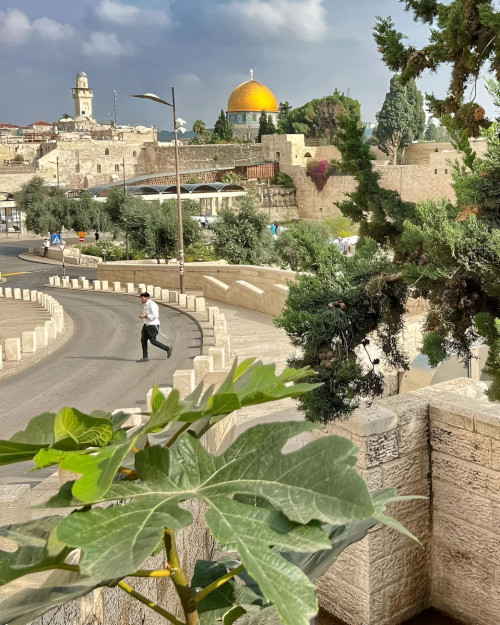
Geographical location of the Holy Land
The history of the Holy Land was greatly influenced by its geographical location. It is bounded by the Mediterranean Sea to the west and by mountain ranges and desert to the east. The coastline is straight, with few natural harbours. The country's history has therefore been shaped by its relationship with the countries to the north and south and with the nomadic tribes who came from the east across the desert. The memory and influence of the successive conquests over the centuries is preserved not only in the ruins that remain in the country, but also in the many colours of the people who settled here.
Holy Land: birthplace of three world religions
The country is called the Holy Land because it is the birthplace of two of the most influential religions of European civilisation, Judaism and Christianity. Islam, too, is attached to the Holy Land and its holy places. The name of some areas of the Holy Land has changed frequently over time with the arrival of new conquerors, and so have its borders. The Holy Land is often called Palestine, which comes from the Hebrew word Peleset and the Latin Philistia.
Names of Palestine and the Holy Land over time
For a long time, the Holy Land was called Palestine. In 1948, when the Jewish people proclaimed their independent state, the Holy Land was named Israel - a name that dates back to the time of the Jewish patriarchs.
This area linked two great civilisations: Egypt in the south and Mesopotamia in the east, where the Tigris and Euphrates rivers watered the fertile crescent. Two major ancient trade routes passed through here.
The Via Maris - the ancient trade route
The Via maris, or Sea Route, started north from Egypt, crossing coastal plains and low passes to Meggido, where it split. One branch continued along the coast , the other branch led to Hacor and Damascus. The other was the Royal Road, following the right bank of the Jordan.
Sources for the history of the Holy Land
We know the history of the Holy Land from various sources. Much of the important information has been provided by archaeology, which has been extracted from the remains of ancient settlements still visible today. Most of the excavations in Israel have been carried out in so-called settlements, sites that have preserved the remains of human settlement over centuries and millennia. Archaeologists open sections at tell settlements and uncover layers of settlement that are stacked on top of each other. By comparing the finds from one layer with those from other sites of similar date, it is possible to identify the cultures that once inhabited the Holy Land.
The Bible contains the most information about the history of the Holy Land. The Old and New Testaments contain a total of 475 place names, many of which can be identified with an archaeological site that has already been excavated. Sometimes battles mentioned in the Bible also turn up. The historical works of antiquity also contain many valuable descriptions. Perhaps the most important historian of this land is a Roman Jew, Josephus Flavius.
The Egyptian tomb inscriptions and the clay tablets found in the palace at El Amarna also contain important data. The Dead Sea Scrolls, unearthed in 1947, have proved to be a treasure trove, although they are still the subject of heated debate among scholars today.
Read part 2 of the topic here: History of the Holy Land Part 2